Skipping rope: the basics | Weight vest: more resistance | Resistance bands: warm-up and strength | Calisthenics: parallettes and gymnastic rings | The Complete outdoor training | Your outdoor setup
Training outdoors is the best decision you can make this summer. A skipping rope is the perfect starting point: compact, versatile, and ready to use on any surface. Combine it with the right gear and you have a complete workout you can do anywhere.
Discover which tools take your outdoor training to the next level and how to combine them smartly.
Skipping rope: the foundation of your outdoor training
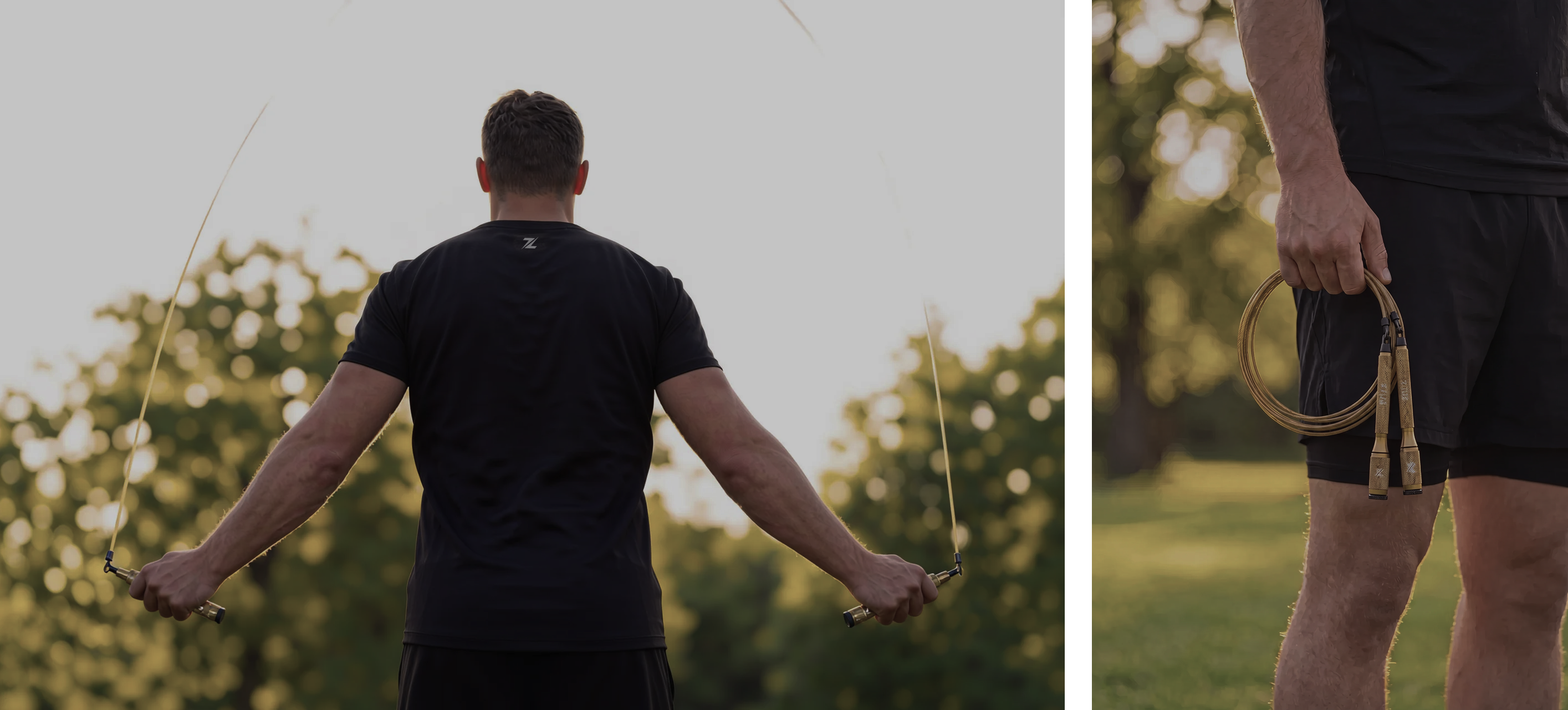
The skipping rope is the most underrated fitness equipment there is. You carry it in your gym bag, need minimal space, and in ten minutes you have an effective cardio session ready. No machine, no subscription, no excuse.
What makes skipping ropes so effective
Skipping trains your cardiovascular system, improves your coordination, and strengthens your ankles, calves, and core simultaneously. It is known as one of the most efficient cardio forms with less strain on your knees. This makes it especially suitable as a daily outdoor workout, even on days when you don’t feel like a full running session.
Which skipping rope suits you?
Not every skipping rope is the same. The choice depends on your training goal, level, and how you train. These are the four main types at ZEUZ:
- Skipping SR-1: Lightning fast and smooth, ideal for beginners learning double unders and advanced users completing high-intensity sets.
- Skipping SR-2: The go-to skipping rope for CrossFit, HIIT, and boxing training. The set includes two cables and a storage pouch, so you always have a spare cable on hand.
- Skipping Rope SR-3: The weighted handles actively engage your arms and grip with every jump, training both your endurance and strength in one session.
- Tornado Pro Speed Rope Set: The most complete model. Switch between a light cable for maximum speed and a heavier one for resistance training, with weighted handles that grow with your level.
View all models and find the perfect Skipping rope for your training.
Determining the correct rope length
A Skipping rope that is too long or too short immediately hinders your technique. The rule of thumb: stand in the middle of the rope and pull both ends up. The handles should reach your armpits. For double unders, the rope can be slightly longer for extra spinning room.
Technique: how to jump efficiently
Many people jump too high or move their arms too much, causing quick fatigue. Follow these points:
- Jump on the balls of your feet, not on your heels
- Keep your elbows close to your body and move only your wrists
- Jump just high enough for the rope to pass underneath, about 2 to 3 centimeters
- Keep your gaze straight ahead and your core slightly engaged
Whether you are just starting with double unders or already working on your triple unders: a Skipping rope for CrossFit comes in versions for every level.
Weight vest: more resistance outdoors
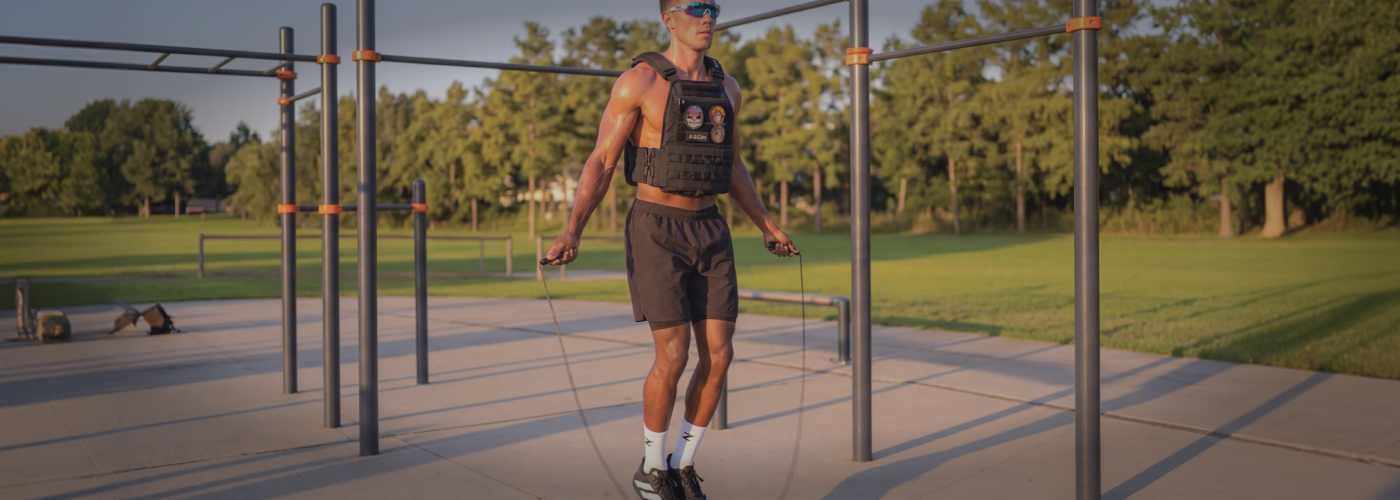
A weight vest is one of the smartest investments for outdoor training. You add extra load to your own body weight without needing loose weights. The result: more muscle stimulation with the same movements.
How to choose the right weight?
A common mistake is starting with too much weight. For most athletes: start with 5 to 10 percent of your body weight. At that level, you clearly feel the extra resistance without your technique suffering or your joints becoming overloaded. Only increase the weight once you can perform the exercises flawlessly for 4 weeks.
Exercises that benefit most from a weight vest
Not every exercise is equally suitable for extra load. These are the most effective combinations outdoors:
- Pull-ups on a climbing frame or gymnastic rings: the weight vest significantly increases the load on your back, biceps, and shoulders
- Push-ups: a light addition of weight makes your chest and triceps work much harder
- Burpees: add a vest and a simple bodyweight exercise becomes a full conditioning tool
- Walking or sprinting on a slope: the vest increases heart rate and engagement of the glutes and hamstrings
- Box jumps on a bench or stairs: focus on a soft landing and reduce the weight during explosive exercises
Why the vest also improves your endurance
The weight vest is not only for strength. The extra weight makes your heart work harder with every movement, even during low-intensity activities like walking. This makes it an effective tool for improving your overall fitness and increasing your daily calorie burn.
The weight vest works excellently in combination with your Skipping . Do a set of skipping, followed by a round of exercises with the vest. This way, you train strength and endurance simultaneously in one efficient session.
Resistance bands: warm-up and strength
Resistance bands are the perfect addition to your outdoor routine. They are light, fit in any sports bag, and provide resistance in every direction of movement. Attach them to a tree, pole, or fence, and you have a complete training station.
How resistance bands work
The further you stretch a resistance band, the heavier it becomes. This means your muscles work harder as you extend the exercise movement, even at the point where the movement normally feels easiest. This way, you train your muscles throughout the entire movement, resulting in more muscle stimulation and better results.
Use the bands for all three phases of your workout
- Warm-up: activate hips, shoulders, and knees before your workout. Think of clamshells to activate your hips, pull-aparts to loosen your shoulders, and banded squats to warm up your glutes.
- Strength training: squats, Romanian deadlifts, rows, and shoulder presses are fully doable with just bands. Combine multiple bands for more resistance.
- Cool-down and mobility: use a light band for stretches of the hamstrings, hips, and shoulders. This speeds up recovery and improves your mobility in the long term.
Resistance levels and what they mean
Bands come in different thicknesses, each with a different resistance range. A light band (10 to 25 kg resistance) is suitable for mobility and warm-up. A medium band (25 to 50 kg) works well for strength exercises like rows and presses. Heavy bands (50 kg and more) are suitable for assisted pull-ups and heavy squats. Start with a lighter band than you think you need.
Calisthenics outdoors: Parallettes and Gymnastics Rings
Training outdoors with parallettes or gymnastics rings is the most complete form of functional strength training you can do without a gym. You train strength, stability, coordination, and body tension simultaneously, in a way no fitness machine can match.
Why calisthenics outdoors is so effective
In calisthenics, you use your own body weight as resistance. This means you always train the right ratio: you get stronger in movements that are relevant to your body. Additionally, you automatically train the small muscles that keep your body stable, something that is largely lost with machine training. For functional strength and body awareness, calisthenics is the most efficient method.
Parallettes: the foundation of calisthenics
Parallettes give your wrists and shoulders the space to move freely, which is not possible with push-ups on the floor. This increases the range of motion and reduces strain on the wrists.
Exercises and progression
- Dips: start with a straight arm support (hold yourself up on the parallettes) and build up to full dips with controlled downward movement
- L-sit: start with a tuck sit, knees to chest. Once you can hold that for 10 seconds, extend one leg. Eventually, work towards a full L-sit with both legs extended.
- Handstand push-up: first work on a pikestand (hips high, feet on the ground) before moving on to a full handstand push-up against a wall
- Planche progressions: the planche is one of the most difficult calisthenics skills. Start with a tuck planche lean and gradually increase the angle over several months
Gymnastics rings: unstable force
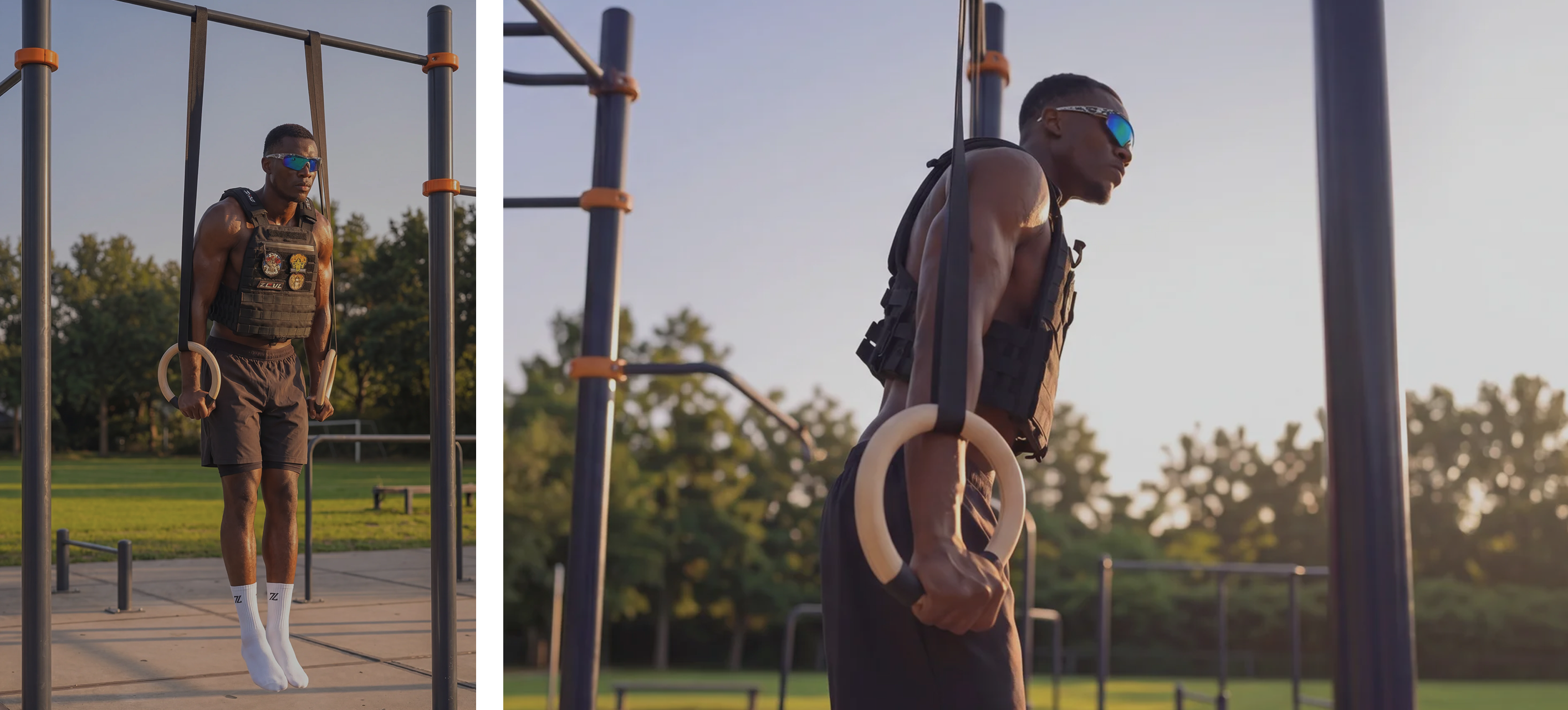
Gymnastic rings hang freely, which means your body constantly makes small corrections to keep the rings stable. This activates your stabilizers in a way fixed bars cannot.
Exercises and progression
- Ring rows: an accessible alternative to pull-ups. The more horizontal you hang, the harder the exercise.
- Ring dips: heavier than parallette dips due to instability. Keep your wrists neutral and your rings turned inward at the end point.
- Muscle-ups: the combination of a pull-up and a dip in one smooth movement. Requires explosiveness, timing, and body tension.
- Front lever progressions: start with a tuck front lever and build up to a full front lever for extreme back strength
Hang your gymnastic rings on a branch or climbing frame and you immediately have a complete outdoor workout. Combine a set on the rings with a warm-up on the Skipping for a workout that perfectly balances strength and endurance.
The Complete Outdoor Training: how to combine it
Now that you know all the tools, it’s time to bring them together. Below is an example of a complete 45-minute outdoor workout you can do right away in the park.
Warm-up (10 minutes):
- 5 min Skipping (low intensity, double jumps)
- 5 min resistance band activation: loosening hips, shoulders, and knees
Training block, 4 rounds (25 minutes):
|
Exercise |
Duration / Repetitions |
|
Skipping, as fast as possible |
1 minute |
|
Ring dips on gymnastic rings |
10 repetitions |
|
Push-ups with weight vest |
10 repetitions |
|
L-sit on parallettes (3 sec hold) |
8 repetitions |
|
Resistance band rows |
12 repetitions |
Rest 90 seconds between rounds.
Cool-down (10 minutes):
- Stretching with resistance bands (hips, hamstrings, shoulders)
- 2 minutes of slow Skipping for active recovery
Progress over weeks
Do this routine 3 times a week and adjust it every two weeks. Add a fifth round, increase the weight of the vest, or add an extra minute of Skipping at the start of each round. Small adjustments ensure consistent progress without needing to replace the routine.
Your outdoor setup starts here
With the right equipment, you can train anywhere. The beauty of outdoor training is the freedom: no queues, no fixed opening hours, just perform at your own time.
Ready to get started? Assemble your complete outdoor setup through the ZEUZ assortment.