Equipment for an effective home gym workout | Best home gym exercises | Making progress in a home gym | Home gym workout plan | Start today
No time for the gym, no desire to wait in line for the machines, or simply prefer to train at your own pace? Fair enough. And training in a home gym is just as effective as training at the gym, provided you approach it intelligently.
In this blog, you will read exactly what you need, which exercises deliver real results, how to keep making progress, and you will get a concrete workout plan to start today.
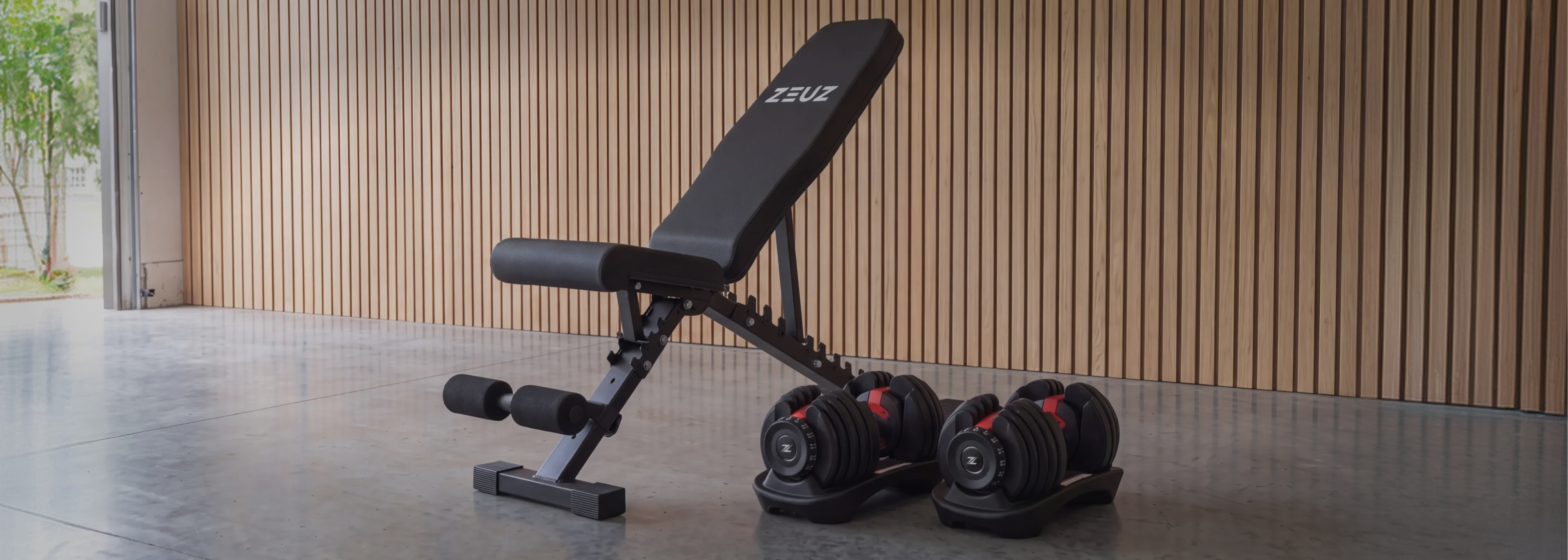
Would you rather not choose individual products yourself, but start with the right foundation right away? The Home Gym Core Pack gives you everything you need to start your own home gym workouts in one go.
What do you need for an effective home gym workout?
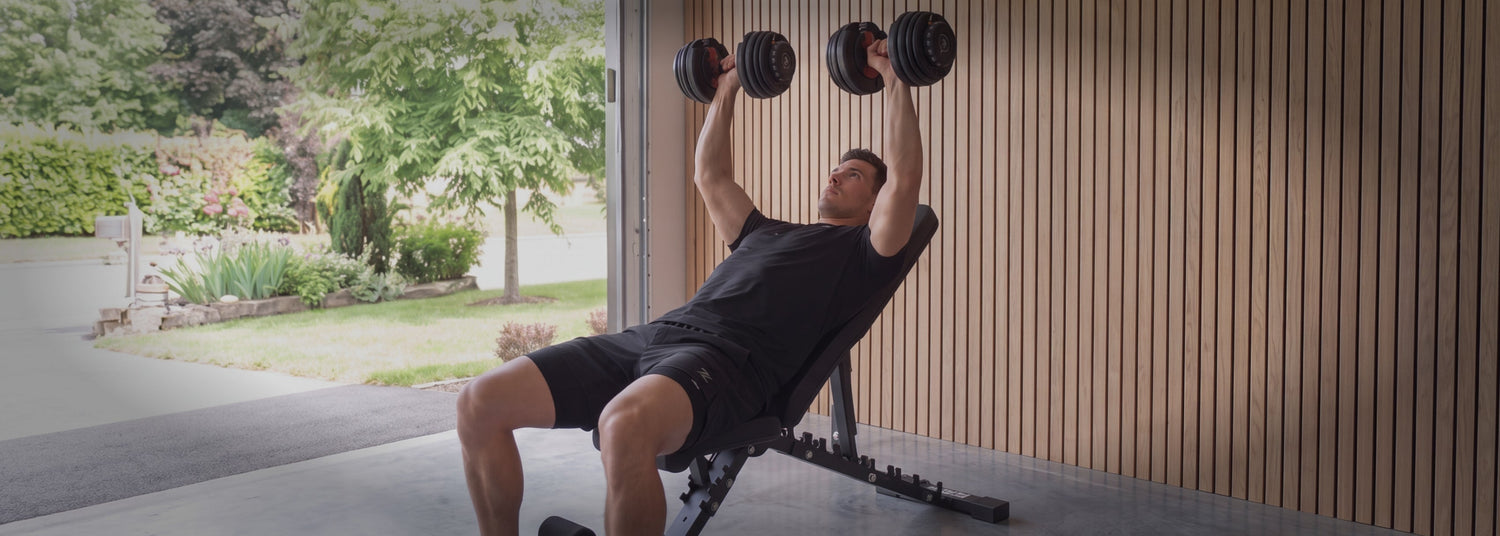
Forget the idea that you need to recreate a complete gym. With two core products, you can cover virtually every basic exercise: an adjustable weight bench and a set of adjustable dumbbells.
Why exactly these two? Because this combination gives you three things that help you keep making progress in your workouts:
- Weight flexibility: with adjustable dumbbells, you can increase the weight in small increments without needing an entire collection of individual weights.
- Angle variety: an adjustable weight bench lets you switch from flat to incline to decline, allowing you to target a different muscle group or angle with the same bench each time.
- Free weights: they force your body to stabilize the movement itself, so you also train your stabilizing muscles and core.
Together, they form the foundation of a complete, scalable training program. A beginner today and an advanced athlete in a year.
Do you have absolutely nothing at home yet and want to arrange everything at once? Discover which essential products you need for your home gym and how to quickly and easily build your own home gym.
.png)
What are the best exercises for a home gym?
Once the basics are in place, everything comes down to choosing the right exercises. Preferably choose compound exercises: movements that engage multiple muscle groups at once, such as a chest press or a squat. They deliver more results per minute than isolation exercises (such as curls) and are therefore the backbone of any efficient home gym routine. Add isolation exercises afterward to give specific muscle groups extra stimulation.
Dumbbell exercises for home
Dumbbells are your most versatile tool. With a few movements, you can train virtually your entire body:
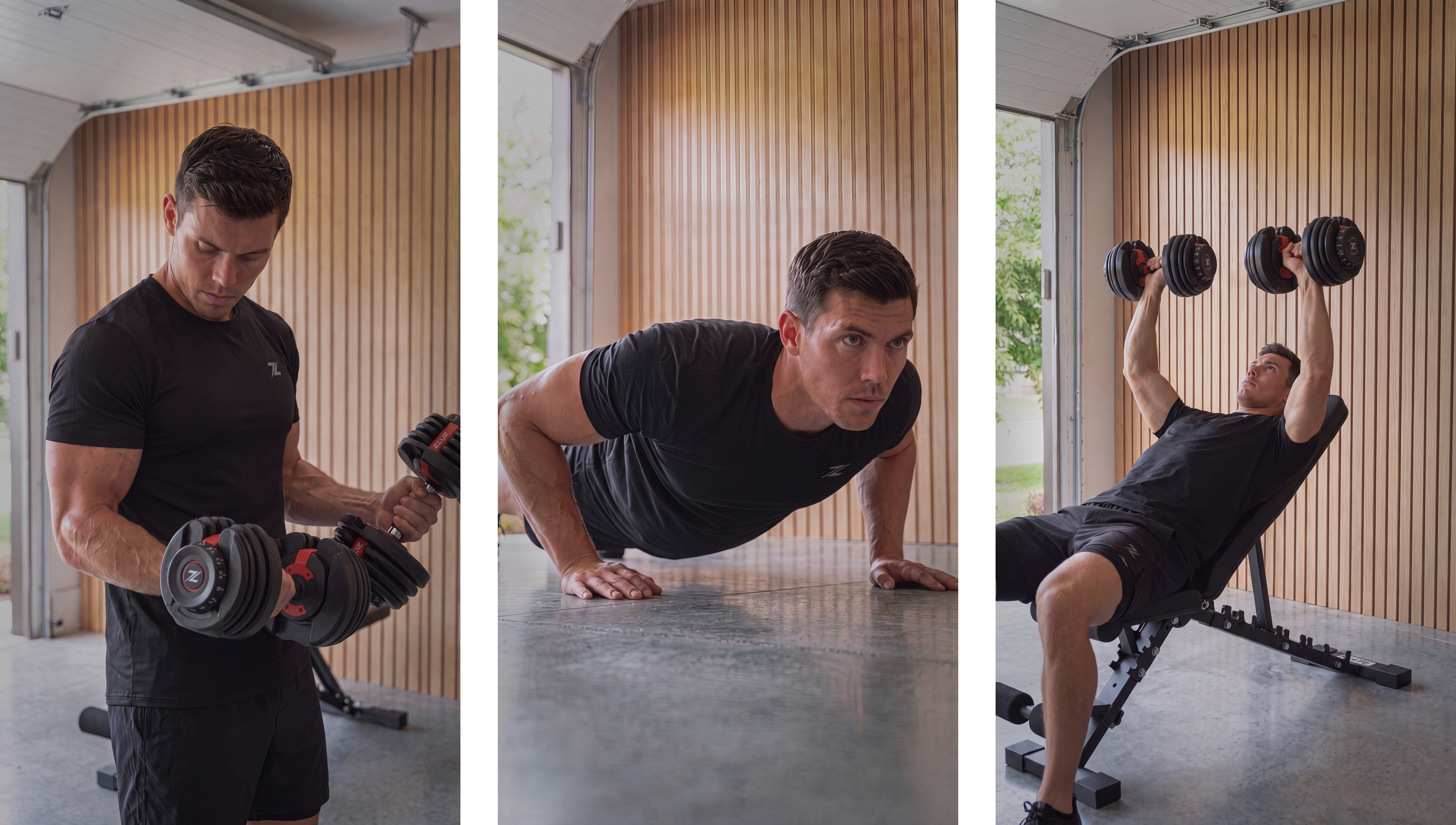
- Chest press: for the chest, shoulders, and triceps. Keep your elbows at a slight angle and press the dumbbells straight up without letting them 'clap' together at the top.
- Rows: for a strong back and better posture. Pull the dumbbell toward your hip rather than your shoulder to keep the tension on your back muscles.
- Shoulder press: for broad, stable shoulders. Press vertically upward and avoid arching your lower back.
- Lunges: for your legs and glutes, with added core stability. Take a firm step forward and lower your back knee until it is just above the floor.
- Curls: for directly building your biceps. Move in a controlled manner without swinging your shoulders.
Exercises with a barbell bench
A barbell bench adds angle variation and stability to your routine:
- Incline press: puts more emphasis on the upper chest muscles. Set the bench to 30–45 degrees for the best results.
- Decline press: targets the lower chest muscles and takes the strain off your shoulders.
- Step-ups: build leg strength and balance. Push through your heel, not your toes, to engage your glutes as effectively as possible.
- Bulgarian split squats: an intense leg exercise that focuses on one leg at a time, ideal for identifying and correcting left-right imbalances.
Also read why a barbell bench is truly indispensable in your home gym.
Bodyweight exercises
No barbell bench or dumbbells on hand? You can still work out effectively using only bodyweight exercises:
- Push-ups: for the chest, shoulders, and triceps. Keep your body in one straight line from head to heel.
- Squats: for complete leg strength. Squat as deeply as your mobility allows, keeping your knees aligned with your toes.
- Planks: for a strong, stable core. Actively engage your abdominal and glute muscles instead of simply 'hanging'.
How do you make progress in a home gym?
Muscles do not grow from repetitions; they grow from progress. This principle is called progressive overload: challenging your body just a little more each time than the time before. There are four ways to do this:
- Add a little more weight
- Do one extra repetition
- Shorten your rest between sets slightly
- Increase your tempo or range of motion
The variant that works best depends on your goal. If you train for strength, focus on 1 to 6 repetitions with a heavier weight. For muscle growth (hypertrophy), a range of 8 to 12 repetitions works best. If you mainly want to build endurance, aim for 15 repetitions or more with a lighter weight.
With adjustable dumbbells, you can apply this immediately: increase the weight in small increments without having to buy a new set. Your adjustable weight bench also plays a role. By changing the angle, you give your muscles a new stimulus using the same bench. This way, your home gym continues to grow with your level.
Please note: progress is not a straight line upward. Have you noticed that you have plateaued for several weeks or feel more tired than usual? Then consciously schedule a lighter week, known as a deload, with less weight or volume. This gives your body a chance to recover and then move forward again.
Your complete home gym workout plan
Ready to put it into practice? The schedule below follows an upper/lower split: you train your upper and lower body on separate days, with a full-body day as an addition. This gives each muscle group enough recovery time while still allowing you to train 3 to 4 times per week. Perform each exercise for 2–4 sets of 8–12 repetitions, with 45–90 seconds of rest between sets. Long enough to recover, but short enough to keep the intensity high.
Begin every workout with 5 to 10 minutes of warming up: light cardio and dynamic stretching. This prepares your muscles and joints for the strain and reduces the risk of injury.
Workout 1: Upper Body
- Dumbbell Rows: 4 x 10 repetitions (90 seconds rest)
- Dumbbell Chest Press: 3 x 10 repetitions (90 seconds rest)
- Incline Dumbbell Chest Press: 3 x 10 repetitions (90 seconds rest)
- Dumbbell Curls: 3 x 12 repetitions (60 seconds rest)
- Push-Ups: 2 x as many repetitions as possible (60 seconds rest)
Workout 2: Lower Body
- Goblet Squats: 4 x 10 repetitions (90 seconds rest)
- Bulgarian Split Squats: 3 x 10 repetitions per leg (90 seconds rest)
- Step-Ups: 3 x 10 repetitions per leg (90 seconds rest)
- Lunges: 3 x 12 repetitions per leg (60 seconds rest)
- Planks: 3 x 30–45 seconds (45 seconds rest)
Workout 3: Full Body
- Goblet Squats: 3 x 10 repetitions (90 seconds rest)
- Dumbbell Rows: 3 x 10 repetitions (90 seconds rest)
- Dumbbell Shoulder Press: 3 x 10 repetitions (90 seconds rest)
- Step-Ups: 3 x 10 repetitions per leg (60 seconds rest)
- Push-Ups: 2 x as many repetitions as possible (60 seconds rest)
Progress this routine weekly by adding slightly more weight, one extra repetition, or reducing your rest time.
Why recovery is just as important as training
Don't underestimate your rest days. During your workout, microscopic tears develop in your muscle fibers, which is exactly the stimulus needed to become stronger. But actual growth doesn't happen at the gym or in your home gym; it happens afterward. During rest, your body repairs those fibers through muscle protein synthesis, building them back slightly thicker and stronger than before.
If you consistently skip that rest, fatigue accumulates before your muscles have a chance to recover. The result: stagnation, a greater risk of overtraining, and ultimately less progress instead of more. So don't view rest as 'doing nothing', but as an essential part of your training. Just as important as the repetitions you perform at the gym or in your home gym.
Therefore, schedule a rest day after at least two consecutive workouts. This gives your body a chance to recover before adding the next training load and prevents fatigue from building up unnoticed.
Start strength training in your home gym today
Ready to get started? Shop the ZEUZ Home Gym Core Pack and start building your own workout routine today.